Effortless Effort
The Path to Perfection in Asana
Table of Contents
When I tell people I’m a yoga teacher, I get all kinds of responses.
Some people are curious. Some are inspired. Some assume it’s a hobby and ask what I “really” do. Others seem to understand, without needing much explanation, that teaching yoga is a commitment — not only to a subject, but to a way of living and seeing.
And then there was the person who once said, with genuine enthusiasm:
“You’re a yoga teacher? Wow. That must be so relaxing.”
I laughed. Not because it was wrong exactly, but because it was only one small part of the story.
Many people come to yoga to unwind. To soften stress. To feel calmer, clearer, more at home in themselves. So it makes sense that yoga is often associated with relaxation.
But is yoga always relaxing?
And if your practice is not relaxing — if it is challenging, confronting, or even uncomfortable — does that mean you’re doing it wrong?
What Effortless Effort Really Means
Early in my yoga life, one of my teachers introduced the phrase effortless effort.
I loved it immediately.
To me, it pointed toward a kind of practice that is deliberate but not forceful. Attentive but not aggressive. Committed, but not clenched.
It suggested that yoga could eventually unfold with a sense of ease, but not because it was easy. Rather, because the effort had become refined. Intelligent. Integrated.
Over the years, I have had glimpses of this in my own practice — moments where the body, breath, and mind seem to organize around one clear intention. Moments where an asana feels less like something I am imposing on myself, and more like something I am listening my way into.
But I have also known plenty of what I might call effortful effort.
And truthfully, I do not think I could have arrived at one without the other.
When Practice Was Not Relaxing
When I first began practicing yoga, I was living with chronic and debilitating back pain.
There was nothing effortless about it.
Almost everything hurt.
At that time, I began to develop an internal line between being committed to my practice and being aggressive in it. I did not have sophisticated language for it yet, but I understood that not all discomfort was the same.
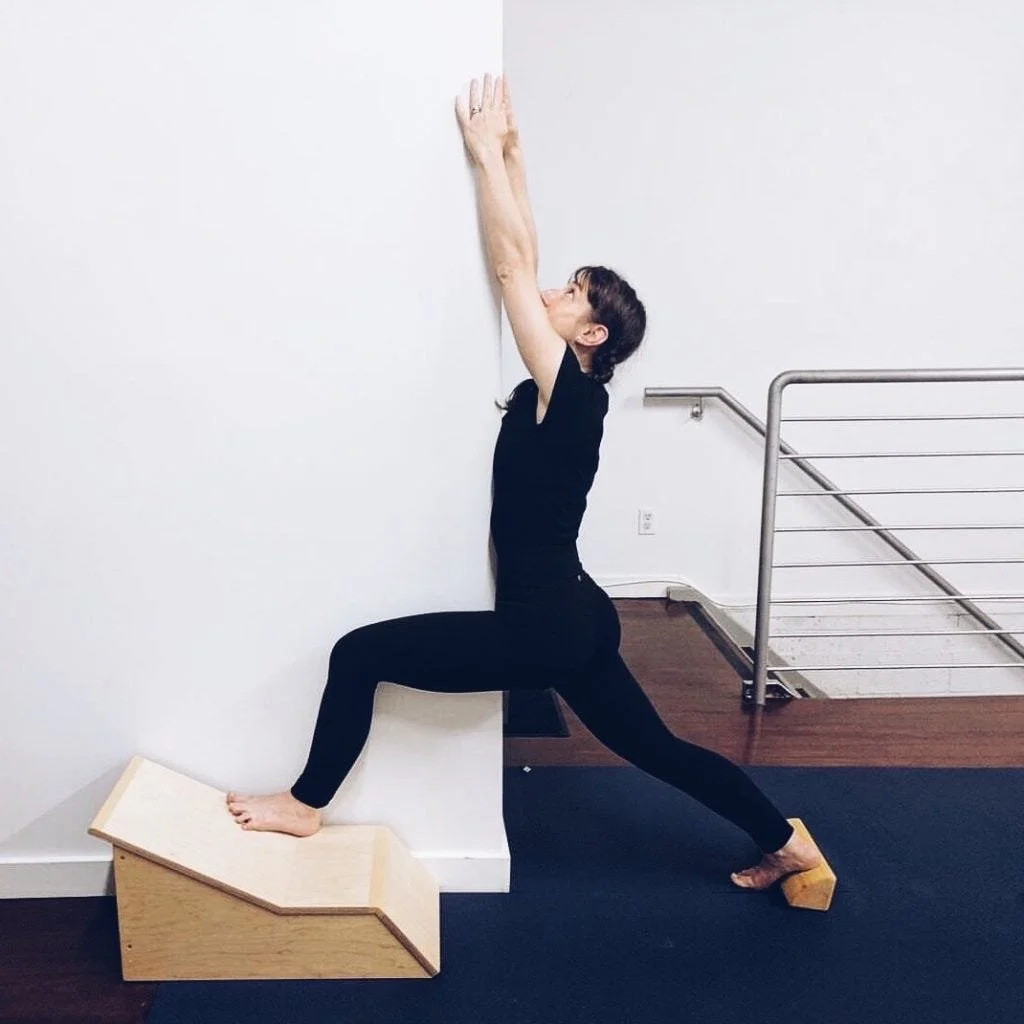
Virabhadrasana I (Warrior I) has been a nemesis pose. This setup allows me to approach the asana ‘effortfully’ but not aggressively.
There was the kind of discomfort that came from waking up dormant muscles, building strength, creating stability, and learning to inhabit my body differently.
And then there was the kind of pain that clearly said:
Do not continue.
Sharp pain. Intense pain. Pain that felt inherently wrong.
I sometimes thought of this as the difference between “good pain” and “bad pain,” though I would be more cautious with those terms now. Pain is complex. It is subjective. It is influenced by our history, our nervous system, our habits, our fears, and our hopes.
Still, learning to listen closely enough to make distinctions was an important part of my yoga education.
Not all effort was harmful.
Not all discomfort was a warning.
And not all ease was truth.
The Discipline of Discernment
This is where yoga becomes so much more than a feel-good practice.
Yoga asks us to pay attention.
Not in a vague or sentimental way, but in a precise and ongoing way. What am I feeling? Where am I feeling it? Is this sensation familiar or new? Is it useful? Is it overwhelming? Am I resisting because something is wrong, or because something is unfamiliar?
These are not always easy questions to answer.
In fact, part of the practice is learning that our first interpretation of an experience is not always the whole truth.
Comfort can be a habit.
Discomfort can be a doorway.
And discernment is the practice of learning the difference.
Learning From Scoliosis
One of the spinal conditions I live with is scoliosis.

Because of this, it is not uncommon for a teacher to adjust me in an asana. The strange thing is that when a teacher helps bring me into a more balanced alignment, I often feel more crooked, not less.
This used to fascinate me.
My body had become so accustomed to its own asymmetry that “straight” felt wrong. What felt normal was not necessarily balanced. What felt familiar was not necessarily accurate.
Over time, I began to understand the value of receiving feedback from outside my own habitual perception. With the help of skilled teachers, props, repetition, and patience, I started to learn what a different kind of alignment could feel like.
Not perfect alignment.
Not someone else’s alignment.
But a more conscious relationship with my own body.
And through that process, I gained strength and length in places I had not known how to access before.
This experience has shaped the way I understand practice and the way I teach.
Sometimes, something new feels wrong simply because it is new.
Sometimes, unfamiliar sensation gets translated by the mind as “pain” because we do not yet have a more nuanced vocabulary for it.
And sometimes, of course, pain is pain — and it needs to be respected.
The work is not to override sensation.
The work is to become more intimate with it.
Effort, Ahimsa, and the Question of Struggle
During my study visits to RIMYI, the Iyengar Yoga Institute in Pune, I often found myself reflecting on this relationship between effort and ease.
On one hand, I watched younger teachers being asked to work with great intensity. They were encouraged to feel more, question more, explore more, and go beyond what they thought they could do. There was sweat. There were shaking limbs. There were groans.
It was not passive work.
On the other hand, when B.K.S. Iyengar practiced, what I witnessed was serenity. His asanas seemed to agree with him. There was no visible conflict, no excess, no strain leaking out around the edges.
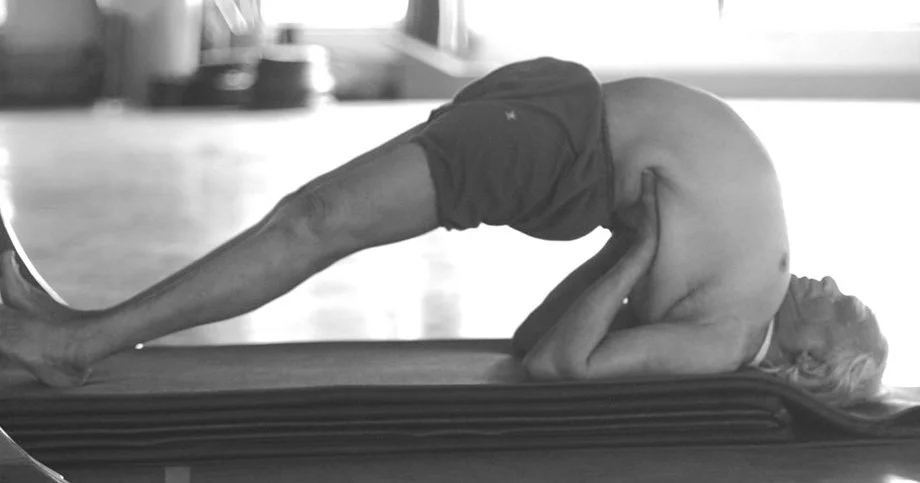
BKS Iyengar demonstrating independent Setu Bandha Sarvangasana, atop the “thick mats”. (Photo Source)
He embodied effortless effort.
At first, I wondered how to reconcile these two things. How could such intensity be part of a yogic practice? How could effort, even struggle, coexist with ahimsa — the principle of non-violence?
I do not think the answer is simple.
But I do think there is a difference between violence and intensity.
There is a difference between forcing the body and educating it.
There is a difference between ambition and devotion.
The same action can be harmful in one context and transformative in another. The same pose can be medicine for one person and entirely inappropriate for someone else.
This is why context matters so much.
There Is No One-Size-Fits-All Yoga
One of the most important lessons I have learned, and continue to learn, is that yoga cannot be reduced to a single external shape.
Context matters.
The length of your torso matters. The proportions of your limbs matter. Your injury history matters. Your nervous system matters. The fact that you just had a baby matters. The fact that you barely slept last night matters. The fact that your body has lived a life before arriving on the mat matters.
There are many ways to approach the same asana.
This does not mean that anything goes. Yoga is not random. Alignment, method, and discipline matter deeply.
But the question is not simply, Is this pose correct?
A better question is:
What is correct for this person, in this body, at this moment, for this purpose?
That question requires more from us than performance.
It requires relationship.
Do ‘Your’ Pose
On my first visit to India to study at the Iyengar Institute, I remember being struck by the photographs from Light on Yoga hanging around the practice hall.
They were extraordinary. Inspiring. Almost mythic.
And, if I am honest, a little intimidating.
Would my asanas ever look like that?
In one of my first classes, Geeta Iyengar pointed to a photograph of B.K.S. Iyengar. We all gathered to look. Then she said something I have never forgotten:
“That is his pose. Now go back to your mat and do your pose.”
Something in me softened.
It was not permission to be careless. It was not permission to stop working.
It was permission to release the fantasy of imitation.
To stop measuring my practice against an image.
To understand that the asana was not something to copy from the outside, but something to discover from the inside.
That moment gave me a felt sense of vairagya — detachment. Not indifference, but a letting go of the grip around outcome.
The Paradox of Perfection
In the Yoga Sutras of Patanjali, as translated by B.K.S. Iyengar, we find this teaching:
“Perfection in an asana is achieved when the effort to perform it becomes effortless and the infinite being within is reached.”
I love this because it holds a paradox.
Perfection in asana is not about achieving a particular shape. It is not about making the pose look like someone else’s photograph. It is not about proving flexibility, strength, or spiritual accomplishment.
It is about effort becoming effortless.
It is about doing, and at the same time, not overdoing.
It is about practicing with purpose, while loosening our attachment to the end result.
This means that every practitioner has access to the possibility of depth in asana.
Not because every body will look the same.
But because every practitioner can learn to bring attention, intelligence, humility, and sincerity to the practice.
The Beauty of the Difficult Path
Some of the richest lessons I have learned through yoga did not come from the poses that felt good right away.
They came from the poses that confused me.
The ones I resisted.
The ones that asked too much, or so I thought.
The ones that revealed where I was gripping, avoiding, collapsing, performing, or protecting myself.
This does not mean that yoga should be painful. It does not mean we should push through injury, ignore fear, or glorify struggle.
But it does mean that discomfort is not always the enemy.
Sometimes the practice asks us to stay present long enough to understand what kind of discomfort we are meeting.
Sometimes it asks us to back off.
Sometimes it asks us to try again with more intelligence.
And sometimes it asks us to stop confusing relaxation with transformation.
Toward Effortless Effort
These days, I do experience more ease in my practice.
Not always. Not perfectly. But more often.
There are moments where the struggle recedes and something clearer emerges. The body becomes alert. The mind becomes quiet. The breath becomes companion rather than project.
But I do not think that ease arrived because I avoided effort.
I think it arrived because, over time, effort became more skillful.
Less dramatic.
Less forceful.
More honest.
Yoga has taught me that effort is not the opposite of ease. When guided by awareness, effort can become the pathway toward ease.
And perhaps this is the heart of effortless effort:
Not the absence of work.
But the refinement of it.
FAQ
-
Not necessarily. While yoga can calm the mind and reduce stress, the practice itself can be physically and mentally challenging. Growth often requires effort, attention, and sometimes discomfort—not simply relaxation.
-
Good pain is often related to building strength, stability, and new awareness—like muscular effort or unfamiliar engagement. Bad pain tends to feel sharp, aggressive, or inherently wrong. Learning the difference is part of developing an intelligent practice.
-
Ahimsa means practicing without aggression toward yourself. It asks for honesty and discernment—working with commitment and courage, while respecting your body’s limitations and avoiding harmful force.
-
A good teacher helps students understand context. Rather than forcing a standard shape, they guide students toward the version of the pose that supports growth, clarity, and safety for their individual body and stage of practice.
Want Po in your inbox?
Stay connected with new articles, videos, and updates from the studio.