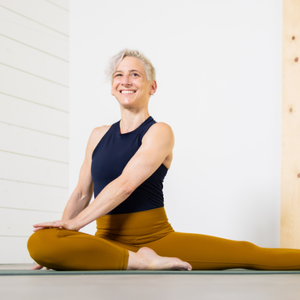
Essential Guide to Iyengar Yoga Online
And what to expect as a student of the method
Table of Contents
Introduction
A Clear Guide to Practicing Iyengar Yoga Online
If you are considering beginning an Iyengar Yoga practice at home, the question is not simply where to start, but how to begin well.
Online yoga offers a range of formats, each with distinct advantages. Understanding these differences—and how they relate to your own learning—will shape the quality of your experience far more than the convenience of practicing from home.
Not All Online Yoga Is the Same
Online yoga is often presented as a single category. It is not.
There are three primary formats through which yoga is taught online:
Interactive Livestream
Webcast
On-Demand
Each offers a different relationship to the teacher, to the practice, and to your own learning process.
1. Interactive Livestream: Learning in Real Time
An interactive livestream class mirrors the structure of an in-studio class. It takes place at a scheduled time, and both teacher and students are visible to one another.
Because the teacher can observe the students, the instruction can be responsive. Adjustments are offered, pacing can shift, and the class evolves in relation to those present.
For many students, this creates a sense of accountability and focus. The act of being seen often encourages a more attentive practice.
2. Webcast: Presence Without Visibility
A webcast is also live, but the dynamic is different. The teacher is visible; the students are not.
You participate in real time, but without the responsibility of being observed.
This format can be particularly useful when space is limited or when a student prefers to work more privately while still benefiting from the structure of a scheduled class.
3. On-Demand: Practice on Your Own Time
On-demand classes are pre-recorded and available at any time.
They offer flexibility, but more importantly, they allow for repetition. A class can be revisited, studied, and understood more deeply over time.
In Iyengar Yoga, where learning is progressive and detail-oriented, this capacity to repeat and observe is especially valuable.
Well-structured libraries also allow students to select classes based on specific needs—whether that is working with a particular area of the body, a category of poses, or a level of experience.
Which Format Is Best?
There is no single answer.
The more useful question is: What supports your learning?
Three considerations matter:
1. The Teacher
The quality of instruction is foundational. A skilled, certified Iyengar Yoga teacher brings clarity, precision, and care to the practice. This matters more than the format itself.
2. The Learning Environment
Some students benefit from structure and accountability. Others require space to move at their own pace. These needs are not fixed—they may change over time.
3. The Available Format
Rather than choosing in theory, it is often best to work with what your chosen teacher offers—and to explore more than one format where possible.
Why Iyengar Yoga Is Particularly Suited to Beginners
Iyengar Yoga is taught systematically, with attention to alignment, sequencing, and progression.
It does not assume that all bodies will approach a pose in the same way. Instead, it provides the tools—often quite literally through the use of props—to make the practice accessible and intelligible.
Belts, blocks, chairs, and bolsters are not accessories. They are instruments of learning. They allow the pose to be adjusted so that the student can understand its action, rather than struggle to achieve its shape.
This is one of the reasons beginners often feel supported within the method.
On Safety in Online Practice
Questions about safety are common, particularly in the context of online classes.
It is easy to assume that visibility determines safety—that if a teacher can see you, you will be safe, and if they cannot, you will not.
This is not accurate.
Teaching safely is a skill. Teaching safely online is a distinct skill.
A teacher who is experienced in the online environment will structure their instruction clearly, anticipate common misunderstandings, and guide students in a way that develops their own capacity to observe and respond.
If you have concerns—due to injury, uncertainty, or previous experience—it is worth reaching out. A thoughtful response will often tell you more about the teacher than the class description itself.
The Student–Teacher Relationship Still Matters
Practicing online does not remove the possibility of connection—it simply changes its form.
A considered online offering will include ways for students to ask questions, receive guidance, and deepen their understanding over time.
This may happen through email, through feedback on classes, or through complementary formats such as occasional live sessions.
What matters is not constant interaction, but meaningful access.
“Am I Doing It Right?”
This is perhaps the most persistent concern for beginners.
The short answer is: you are learning.
Iyengar Yoga is not oriented toward arriving at a correct shape. It is a process of developing sensitivity, attention, and discernment.
A skilled teacher does not simply instruct you what to do. They teach you how to observe, how to adjust, and how to respond.
Over time, this becomes the practice.
A Practical Way Forward
If you are beginning:
Choose a qualified Iyengar Yoga teacher
Start with a format that you can commit to consistently
Allow the practice to unfold gradually
The medium—whether livestream, webcast, or on-demand—will support you differently at different times.
What remains constant is the work itself.
Final Note
Online practice offers a remarkable opportunity: to study consistently, with access to skilled teaching, in a way that can adapt to your life.
But the value is not in the convenience.
It is in the attention you bring to it.
FAQ
-
There is no single “best” format. Beginners often benefit from a combination.
Live classes offer structure and accountability, while on-demand classes allow for repetition and study. What matters most is the quality of instruction and choosing a format you can engage with consistently. -
Yes—if the teacher is skilled in both Iyengar Yoga and online instruction. Safety comes from clear, precise teaching, not visibility alone.
-
A Certified Iyengar Yoga Teacher with clear, precise instruction—and an approach that resonates with you.
Want Po in your inbox?
Stay connected with new articles, videos, and updates from the studio.