Lessons from the Fold
Are Backbends and Forward Bends Opposite?Table of Contents
Some days, the mat teaches you something you didn’t plan to learn.
I remember a time I planned to work on backbends. Strong ones. Uplifting ones. I had envisioned a practice that opens the chest, lifts the mood, and would ultimately send me back into the world taking up my rightful space.
Instead, an hour passed, and I realized I had done almost nothing but forward bends.
Not a single deep backbend in sight.
At first, it felt strange.
Backbends and forward bends feel like opposites, don’t they?
One expands. The other folds.
One feels outward-facing, energizing.
The other draws you inward, quiet, reflective.
Backbends feel extroverted. Forward bends feel introverted.
Different physical shapes. Different mental states.
So why, on a day devoted to backbends, did my body keep choosing to fold forward?
From Frustration to Receptivity
When most people begin practicing yoga, forward bends are surprisingly difficult.
Tight hamstrings and a stiff pelvis: the perfect combination for a spine that rounds rather than propelling itself forward.
In these early days of practice, forward bends are rarely calming. They’re frustrating. Sometimes even painful. And if honest, most will confess that they feel anything but quiet.
Yet over time, many practitioners learn first-hand, that forward bends can soothe the nervous system. They settle the mind, but there’s a caveat – the quiet only comes as a reward for patience and receptivity, not force.
And here’s something less obvious although equally important:
In Iyengar Yoga, we’re taught that in every forward extension, there’s a backbend within it.
That may sound counterintuitive, but once you experience that connection, you simply can’t unknow it.
The Architecture of a Fold
Ever notice how the terms 'forward bend’ and ‘forward extension’ are used interchangeably?
A forward bend is exactly what it sounds like: you fold forward.
A forward extension, to me, evokes something different. It emphasizes that before you fold forward, you lengthen.
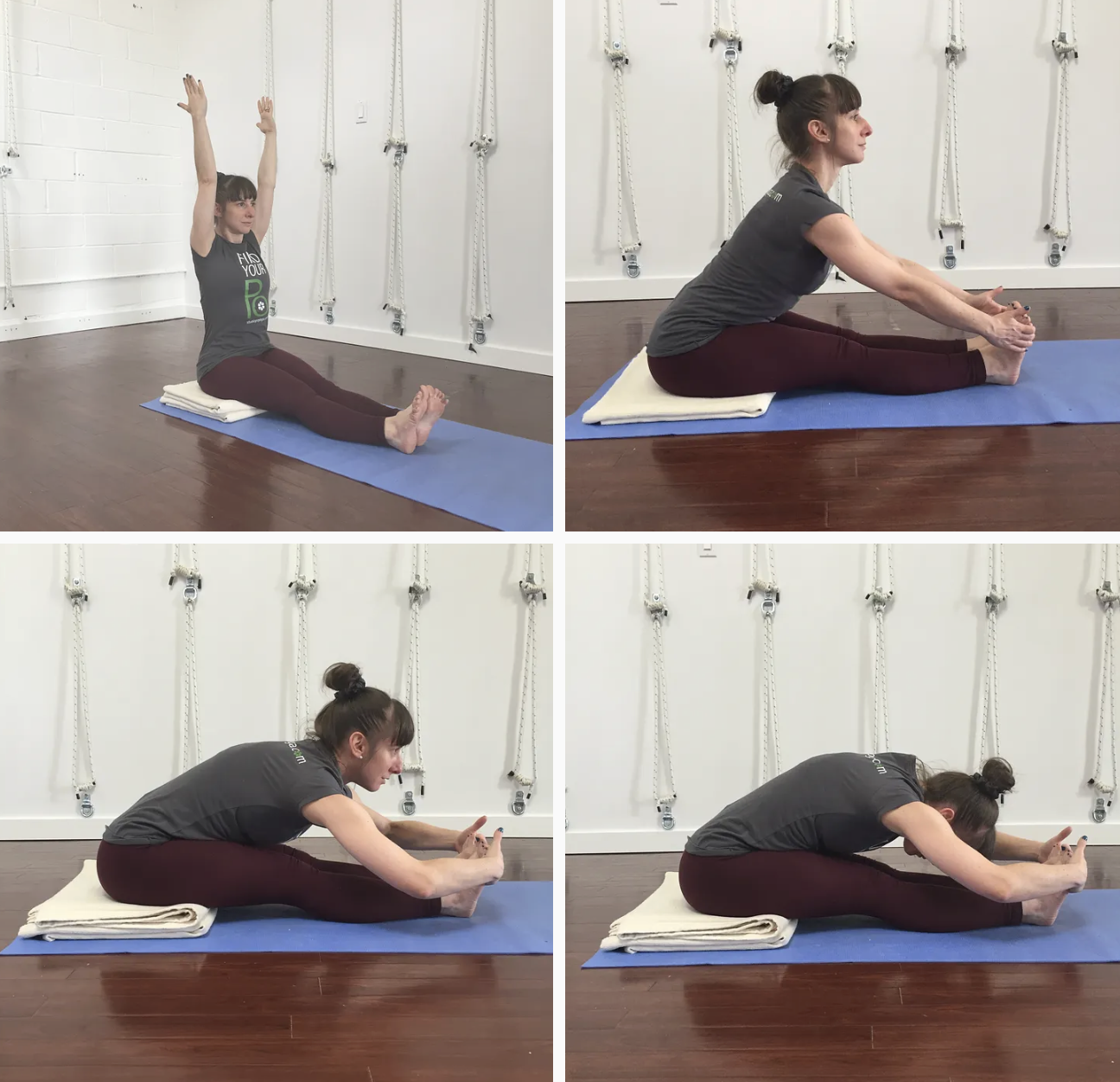
These 4 photos from 2015 demonstrate Urdhva Hasta Dandasana to Paschimottanasana, showing the various stages along the way.
This way of entering a forward bending asana, through a concave back, I’ve always found to be effective (especially for beginners and for those folks who have back pain). Before you move forward, you create space along the spine. You lift and lengthen the sides of the torso too. Then, keeping that length, you extend forward.
Some rounding will happen. That’s natural.
But the intention is different.
You’re not collapsing into the pose.
You’re reaching forward from a place of inner lift and anterior spaciousness.
Suddenly, forward bending as the “opposite” of backbending begins to look and most importantly feel… less opposite.
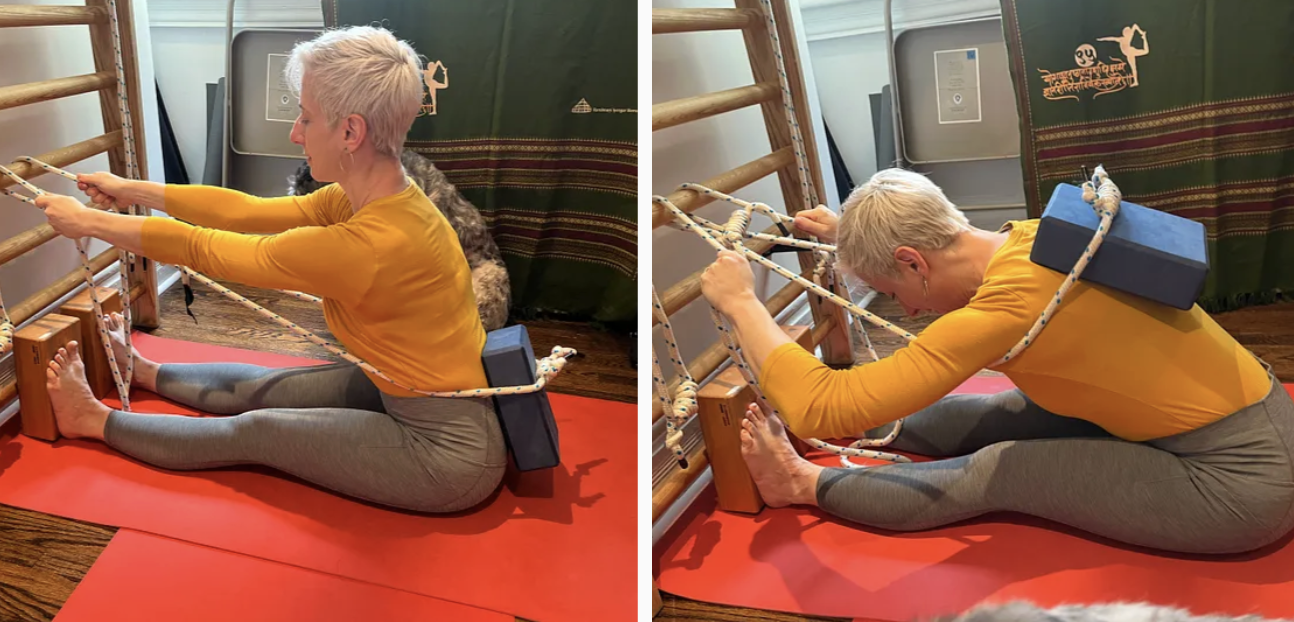
This was a study I did of Paschimottanasana. On the left, I explored concavity, specifically in my sacrum region. On the right, I had entered the full forward bend but was exploring how to further penetrate the thoracic spine.
Learning From What Shows Up
Here’s where my practice surprised me.
When I bend backward, I tend to lose clarity in my legs. My thighs roll out. My inner groins harden and lift. I know what I’m supposed to do, but we all know that knowing and doing are not always the same thing 😉.
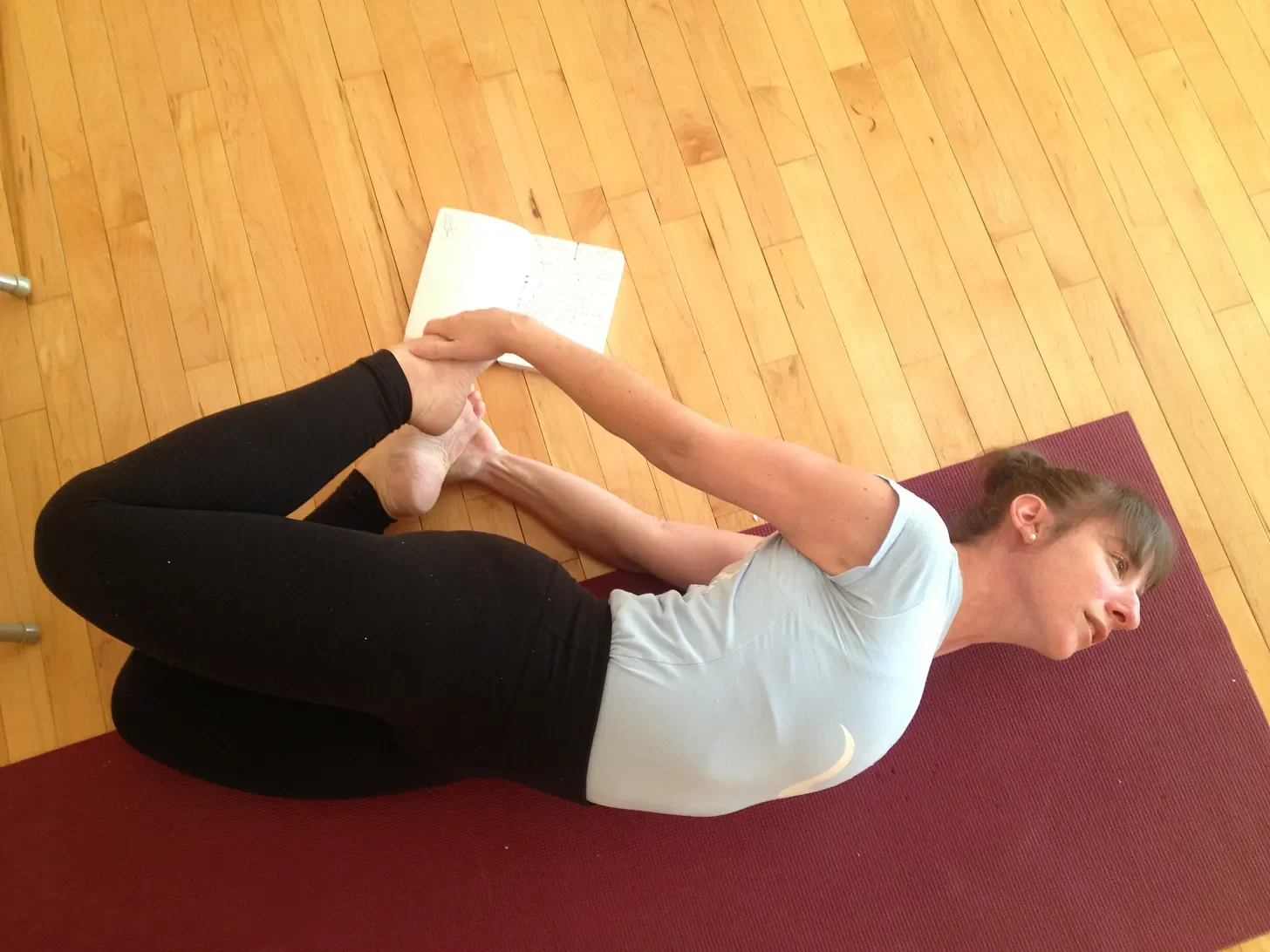
Here’s an old photo of my Parsva Dhanurasana from 2013
Here’s an old photo of my Parsva Dhanurasana from 2013
In forward bends, however, I have more control.
I can feel my legs.
I can soften the inner groins.
I can observe cause and effect.
And that’s when it clicked.
If I can learn these actions clearly in forward extensions, where the feedback is immediate, perhaps that intelligence can eventually carry over into my backbends.
Not by force.
But by understanding.
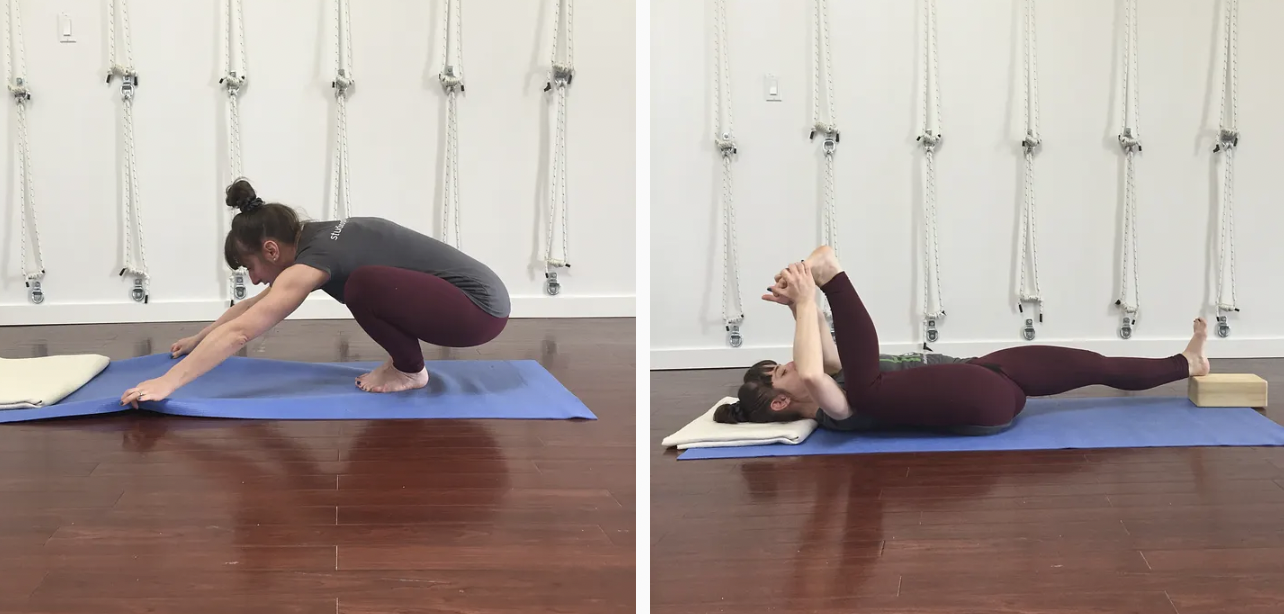
Here are a couple of examples of poses that I would practice to study how to soften and descend the inner groins.
Let the Stronger Teacher Teach
BKS Iyengar was known to say:
If you have a “bad” side, let your good side teach it.
That idea has stayed with me for years.
When something works well in the body, even briefly, it leaves an imprint. A felt sense of what’s possible. From there, I can begin to educate the other places in my body that resist, lag behind, or simply need more time.
In this case, my forward bends had something to teach my backbends.
And perhaps that’s the deeper lesson.
The Way Forward Isn’t Always Forward
Students often get discouraged when a pose won’t come.
“I’ve been practicing this for years. Why isn’t it working?”
But asanas don’t exist in isolation.
They’re part of a big picture.
Sometimes the most direct route forward isn’t forward at all.
Sometimes the way in is through something else entirely.
My day on my mat wasn’t a failure of planning; it was a conversation. One I didn’t know I needed. It was also a testament to non-attachment, discernment, and self-study.
I’m also reminded of a proverb that I quite love:
“We plan, God laughs.”
True in yoga.
True in life.
If you liked this piece, please consider subscribing. Substack is where I’m sharing reflections on practice, patience, and what it means to stay curious in the body over time.
And if you’ve ever found yourself working hard in an asana with little progress, I’ll leave you with this:
Sometimes the breakthrough doesn’t come from pushing.
It shows up when you’re willing to listen and receive.
FAQ
-
Many beginners have tight hamstrings, limited mobility in the hips, or a tendency to round the spine. Learning to lengthen the spine before folding takes time, patience, and consistent practice.
-
In Iyengar Yoga, a forward extension emphasizes creating length through the spine before moving deeper into the pose. Rather than collapsing forward, you first lift, lengthen, and then extend, allowing the movement to be more spacious and supportive.
-
Before folding forward, the spine lengthens and the chest broadens. This action creates extension through the front of the body, helping maintain space in the spine. It's this quality of lift and length that connects forward extensions with the principles of backbending.
Want Po in your inbox?
Stay connected with new articles, videos, and updates from the studio.