What is Intelligence in the Body?
Lessons from Tadasana
Table of Contents

A More Refined Map
In my early days as a yoga student, one of my first teachers said something that has always stayed with me.
He said that, as beginners, we often come to yoga with legs and arms. Then, as we continue to practice, we no longer have just legs and arms. We begin to discover an upper leg and a lower leg, an upper arm and a lower arm. Then, over time, the map becomes more refined still. There is an upper-outer leg, an upper-inner leg, an upper-back leg, an upper-front leg — and on and on.
At the time, I understood what he meant in theory. But over the years, through practice, I have come to understand it in a much more embodied way.
Yoga has shown me how many places in the body can remain dull, vague, or unknown to us — even while we are using them every day. It has also shown me that awareness can awaken in the most surprising places.
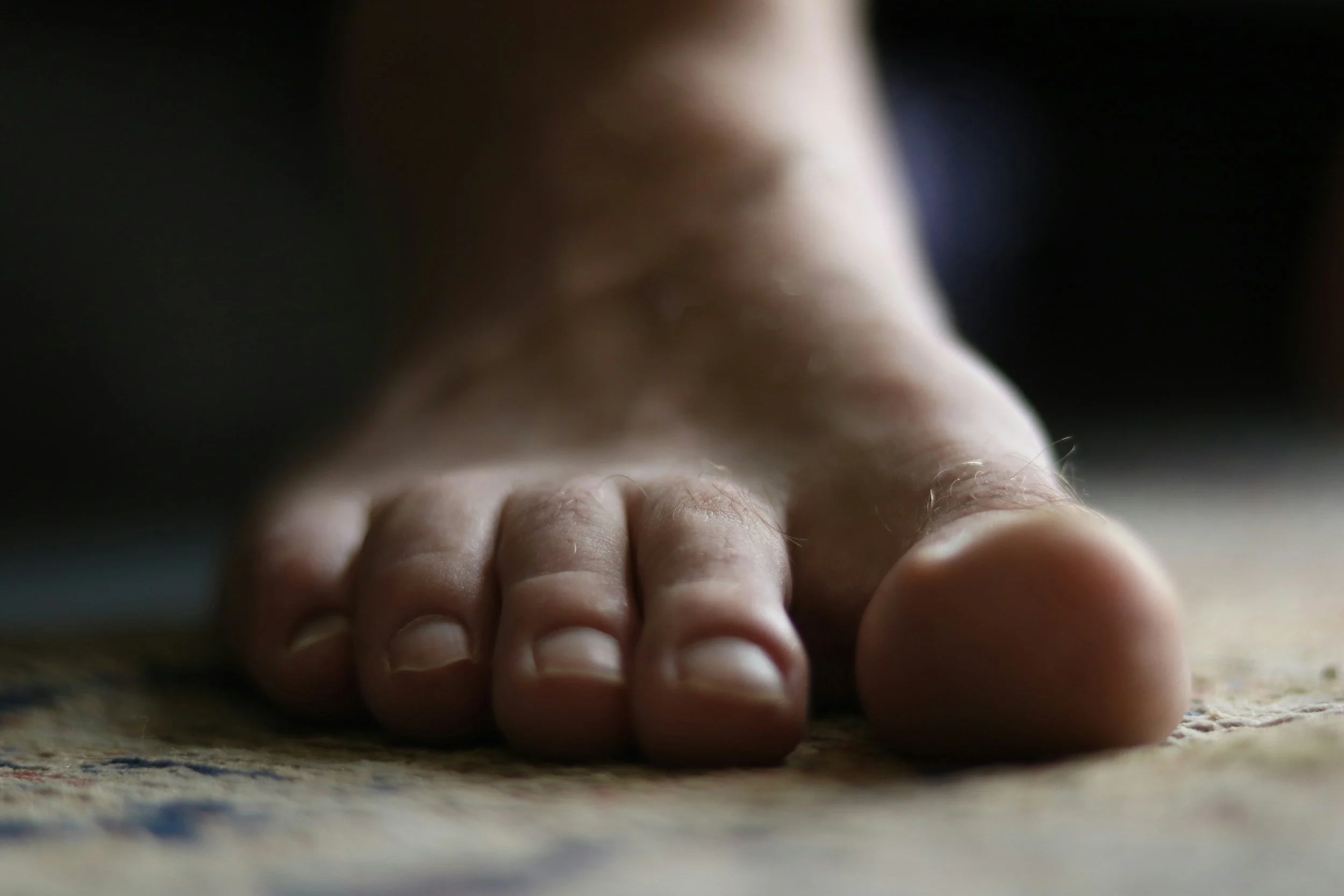
Take the feet, for example.
Having stood on my feet for pretty much my whole life, one might think that my understanding of how they meet the floor would be, at the very least, reasonably well informed. But before Iyengar Yoga, I would say the closest I had come to experiencing intelligence in my feet was the very unpleasant feedback I received from stubbing my toe.
Then I began to practice.
The Feet as Teachers
Tadasana, or Mountain Pose, is often one of the first asanas introduced in a beginner Iyengar Yoga class. On the surface, it seems simple. We are just standing upright.
But almost immediately, this most common position becomes rich with nuance.
Do I stand more on one leg than the other?
Is there more weight on the front of my foot or the back?
Do my arches lift, or do they collapse?
Can I feel all five toe mounds?
Why are some toes easier to sense than others?
Does my inner heel press the floor?
Are my toes gripping?
Does the outer edge of my foot descend evenly?
What happens when I walk?
Why do the outer heels of my shoes always wear out first?
These questions may seem small. But in practice, they are not small at all.
They begin to reveal habits. They uncover patterns. They show us where we are overworking and where we are absent. They bring our attention to the places we have been standing on for years without really feeling.
This is one of the great gifts of Tadasana. It teaches us that standing is not passive. It is alive. It is intelligent. It can be studied.
When Awareness Turns On
For me, developing intelligence in the body meant that I could no longer enjoy the full comfort of “ignorance is bliss.”
Once the light had been turned on, I started to notice things everywhere.
I would stand in line at the grocery store and find myself equalizing the weight between my two legs. I would wait for the subway and look down to see whether my feet were aligned. I would turn my toes slightly in and immediately feel a sense of breadth and release across my sacrum.
I could not believe how powerful such subtle adjustments could be.
And this was not about becoming fussy or perfectionistic. It was not about trying to correct every moment of my life into some idealized shape. Rather, it was about beginning to participate more fully in my own embodiment.
I started to understand that the body is not only a vehicle for moving through the world, but also a way of learning to be in it.

Alignment as a Pathway
In Iyengar Yoga, alignment is often emphasized. Sometimes, from the outside, this emphasis can be misunderstood. It can appear as though the point of the practice is to make the body conform to a particular shape.
But my practice and my teaching changed profoundly when I began to distinguish between alignment for the sake of alignment and alignment for the sake of awareness.
Alignment is not the destination. It is a tool.
It gives us a way to look more clearly. It helps us observe where we are dull, where we are sharp, where we collapse, where we grip, where we avoid, and where we overdo. It gives the mind a precise place to rest its attention.
And sometimes, when the chatter in my head is especially loud, this kind of pragmatic inquiry is exactly what I need. To notice the foot, the leg, the breath, the direction of the skin, the quality of effort — these observations draw me back from the noise of the outside world and into the present moment.
The body becomes a doorway.

From the Body Toward the Breath
As my practice developed, this same mode of inquiry began to move beyond the outer body.
I started to sense more subtle layers of experience. I became more aware of my breath, my energy, my mental state, and the relationship between them. This opened the door to the rich and beautiful practice of pranayama.
I do not think I would have had the discipline, sensitivity, or patience to approach pranayama without first learning how to direct my attention to different parts of the physical body. The work of feeling the feet, the legs, the spine, and the skin helped train me to notice subtleties. It gave me a place to begin.
In yogic philosophy, the kosas are described as layers or sheaths of our being. They move from the physical body, through the breath, the mind, and intelligence, toward a deeper experience of joy.
In Light on Life, B.K.S. Iyengar likens the kosas to the layers of an onion, or to nesting Russian dolls. This image has always resonated with me. I think I have always known, in some intuitive way, that there is a connection between body, breath, mind, and spirit. But the idea of the kosas gives that connection a direction. It allows it to be explored patiently, safely, and with care.

The practice begins at the periphery. We feel the foot on the floor. We notice the leg. We observe the breath. And gradually, over time, we are drawn inward.
A Practice That Meets Us Differently
There is no fixed schedule for the development of awareness.
For one person, yoga may first awaken body awareness. For another, it may bring attention to the breath. For someone else, it may reveal mental patterns, emotional habits, or a deeper longing for steadiness and meaning.
The path is different for everyone.
This is one of yoga’s most remarkable qualities. The same practice can meet different people in different ways. It can also meet the same person differently at different stages of life.
Tadasana may begin as a lesson in how to stand. But over time, it becomes much more than that. It teaches us how to pay attention. It teaches us how to become more honest with ourselves. It teaches us that intelligence is not limited to the mind.
There is intelligence in the body.
And sometimes, the journey inward begins with something as simple as learning how to stand on our own two feet.
FAQ
-
Tadasana may look simple, but it teaches fundamental awareness. In Iyengar Yoga, standing evenly on both feet, observing weight distribution, and refining alignment help students understand the body more clearly. These details create a foundation for more complex asanas and for deeper self-study.
-
Body awareness helps develop the sensitivity needed for pranayama. Before working deeply with the breath, students often learn to direct attention through asana. This builds the steadiness, discipline, and subtle perception required for quieter practices.
-
The kosas are layers or sheaths of being described in yogic philosophy. They include the physical body, breath and physiological systems, mind, intellect, and a deeper spiritual layer of joy. The kosas offer a way to understand the relationship between body, breath, mind, and awareness.
-
Iyengar Yoga is known for precision because details can create access to awareness. Rather than being rigid or perfectionistic, alignment helps students move from unconscious habit toward conscious understanding of the body, breath, and mind.
-
Intelligence in the body refers to the growing capacity to feel, observe, and respond with awareness. In yoga, this intelligence develops as students begin to notice subtle habits, imbalances, and patterns in the body. Over time, the body becomes not only something we move, but also a way of learning to be more present.
Want Po in your inbox?
Stay connected with new articles, videos, and updates from the studio.