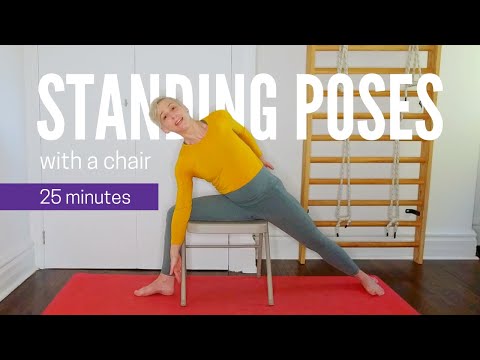
20-Min Iyengar Yoga for Scoliosis | Twists Do's & Don'ts
A 20-minute Iyengar Yoga tutorial exploring how to practice twisting poses with scoliosis. Because every scoliosis pattern is unique, this class demonstrates how twists can be modified to better suit an individual body rather than applying the same instructions to everyone.
Using a right thoracic, left lumbar curve as an example, you'll learn practical approaches to common twisting poses and discover how thoughtful adaptations can help create greater comfort, improved posture, and a more effective yoga practice.
Continue your practice inside Po Online where we build on these foundations with structured classes, progressions, and deeper study.
About This Practice
Twisting poses can be some of the most rewarding—and sometimes the most confusing—asanas for students with scoliosis. Differences from one side of the body to the other often mean that a traditional presentation of a pose may not produce the most beneficial result.
This tutorial explores how to observe your own body and adapt twisting poses accordingly. Rather than focusing on achieving a symmetrical shape, the emphasis is on understanding your individual spinal pattern and making intelligent choices that support healthier movement.
Although the demonstrations are based on a right thoracic, left lumbar scoliosis, the larger lesson applies to all practitioners: yoga is most effective when it responds to the individual body rather than asking every body to move the same way.
What You'll Practice
Modifying yoga twists for scoliosis
Understanding right thoracic, left lumbar curves
Improving spinal awareness
Refining twisting pose alignment
Learning when and how to modify poses
Supporting healthier posture
Developing a personalized yoga practice
When to Use This Practice
When practicing yoga with scoliosis
To better understand twisting poses
When seeking more comfortable spinal rotations
To improve postural awareness
As part of a scoliosis-focused yoga practice
Who This Is For
Students with scoliosis
Practitioners experiencing asymmetry in twisting poses
Anyone interested in adapting yoga to their body
Students exploring therapeutic applications of Iyengar Yoga
Teachers supporting students with scoliosis
Frequently Asked Questions
Should students with scoliosis avoid twisting poses?
Not necessarily. Twisting poses can be very beneficial when they are adapted thoughtfully to the individual's spinal pattern and practiced with care.
Why are twists different for students with scoliosis?
Because scoliosis creates asymmetry in the spine and torso, the experience of twisting is often very different from one side to the other. Appropriate modifications help create more balanced and effective work.
Is this tutorial only for right thoracic, left lumbar scoliosis?
The demonstrations are based on that curve pattern, but the larger principles of observation, adaptation, and individualized practice are valuable for students with many different spinal presentations.
Can twisting poses help improve posture?
When practiced appropriately, twists can improve spinal awareness, mobility, and postural organization. The key is choosing variations that suit your individual body.
Why is personalization so important in Iyengar Yoga?
Iyengar Yoga recognizes that every body is different. Rather than forcing everyone into identical shapes, the practice encourages students to adapt poses intelligently so they receive the greatest benefit.
Is this practice suitable for beginners?
Yes. Beginners with scoliosis can benefit from learning how to approach twisting poses thoughtfully from the beginning, while experienced practitioners will gain additional refinement and insight.
Continue Your Practice
If you enjoyed this class, you can continue your practice across the Studio Po ecosystem:
Practice in-person at Po Toronto
Explore full-length classes inside Po Online
Read reflections and insights on Stephanie’s Blog