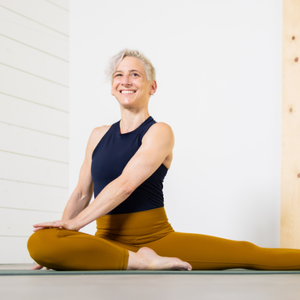
How Iyengar Yoga Teaches Us to Choose
Awareness. Alignment. Autonomy.
Table of Contents
At first glance, Iyengar Yoga might look anything but autonomous. With its emphasis on props, detailed instructions, and precise alignment, it can appear like a method that leaves little room for personal choice.

But here’s the paradox: the very structure that seems rigid from the outside is what cultivates true freedom inside the practice. Iyengar Yoga doesn’t train students to copy; it nurtures them to see, feel, and eventually choose.
Here are five ways this unfolds:
Awareness leads to self-adjustment
Iyengar Yoga emphasizes sensitivity — noticing where the weight falls, which muscles are gripping, how the breath moves. A teacher’s adjustment or a prop may highlight a particular action, but the underlying aim is always to help students feel. The teacher’s role is to cultivate a framework of self-study so that observation naturally leads to action. This process of inquiry and response becomes the foundation of an autonomous practice — and a core tenet of the Iyengar method.
Learning principles, not just poses
Iyengar Yoga is not about memorizing a set of shapes but about understanding principles: extension, grounding, balance, integration. Once internalized, these principles can be applied anywhere — in familiar asanas, in new ones, or even in the way you sit at your desk. They embolden students to adapt inaccessible poses while preserving their integrity. The question shifts from “How do I achieve this pose?” to “How can this asana best serve me?” — a profound act of personal autonomy.
Progress through stages
Props and variations are not limitations; they are pathways. By offering multiple approaches — think of the many ways Utthita Trikonasana can be explored — and progressive stages, such as Parsvottanasana with hands down, then with Baddha Hasta, then with Paschima Namaskarasana, Iyengar Yoga teaches you to recognize what is appropriate for your body on a given day. This nurtures viveka (discernment) — the freedom to pace yourself wisely, rather than force yourself blindly.
Cultivating the witness
Observation is central to Iyengar Yoga. You learn to track not only the body, but also the breath and the mind. What changes when the jaw softens? When the shoulder releases? This ongoing inquiry develops viveka — and over time, becomes a training ground for santosha (contentment). Discernment teaches you to step out of dualistic thinking, to release labels like good/bad or easy/hard. This capacity to be content with where you are and how you are learning is at the heart of autonomy.
Home as the real laboratory
Perhaps the most radical aspect of Iyengar Yoga is its emphasis on personal practice. Class offers guidance, but it is at home where autonomy truly takes root. Alone on the mat, you experiment, apply principles, and adapt to your unique needs. Over time, your yoga becomes a deeply personal dialogue, an integrated practice that shows up like a true friend: patient, supportive, and always there when you need it.
Iyengar Yoga doesn’t cultivate dependence on a teacher. It equips you with tools, shows you how to use them, and then sends you off to explore. The structure of Iyengar Yoga isn’t a cage, but scaffolding. And once you’ve climbed it, you discover the freedom it was supporting all along.
Autonomy in yoga isn’t something handed down — it grows through awareness, inquiry, and personal exploration. As you practice this week, notice: where do you follow, and where do you choose? I’d love to hear your reflections in the comments 💜🙏.
FAQ
-
Structure isn't the goal, it's the starting point. Clear instructions, sequencing, and props create the conditions for deeper awareness, helping students develop the confidence to observe, respond, and eventually practice independently.
-
Yes. While classes provide guidance, the ultimate aim is to help students develop the knowledge and discernment to practice safely and thoughtfully on their own.
-
Props aren't a substitute for practice; they're tools for learning. They help students experience the intended action of a pose, making it possible to adapt the practice while preserving its integrity.
-
The more carefully you observe your body, breath, and mind, the more clearly you can respond. Over time, this process builds discernment and allows your practice to become increasingly personal and responsive.
-
Not at all. Teachers provide guidance, perspective, and refinement throughout your journey. Their role is not to create dependence, but to equip you with the tools to continue learning for a lifetime.
Want Po in your inbox?
Stay connected with new articles, videos, and updates from the studio.