Is Beginner the new Advanced?
The Power of a Beginner's Mind in Iyengar Yoga

A group of beginners practicing Utthita Trikonasana at Studio Po, in Toronto, ON
Table of Contents
In Iyengar Yoga, the Mat Becomes a Laboratory for Exploration
In Iyengar Yoga, the yoga mat is essentially a laboratory for exploration.
Students are not expected to know how to do the poses correctly. Rather, the expectation is that students show up with a willingness to learn, observe, and explore different facets of the asanas.
Yoga is, at its core, a process of self-inquiry, and contrary to popular belief, there’s no such thing as a ‘perfect pose’. In Iyengar Yoga, there is a base-level assumption that growth and self-development are always possible, and yoga asanas are our powerful aids along that journey.
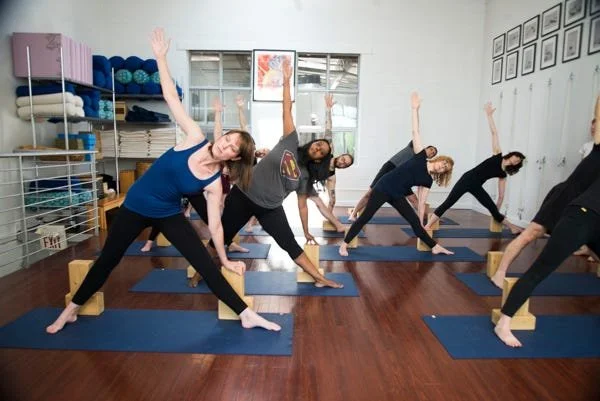
A group of beginners practicing Utthita Trikonasana at Studio Po
A Beginner’s Mind is Ripe for Learning
A little while back, I ran an in-studio beginners’ course. It had been a while since I had run one of these courses, and I was struck by how keen the students were. They were fully engaged, hungry to learn, and fascinated by the subject matter. It was like they took each instruction and literally tried it on. Sometimes it ‘fit’, and sometimes it didn’t, and when it didn’t, I could see them trying to work through it. They may have misunderstood an instruction, or maybe they understood the instruction but couldn’t quite translate the action into their body. Either way, they were fully engaged in the process of their own embodiment and were doing ‘real’ yoga.
As a teacher, it’s a joy to teach students who have committed to the process and are open to whatever learning comes their way. Preconceived notions of what is ‘right’ or ‘better’ don’t loom large or interfere with their personal development.FAQ
BKS Iyengar is known to have said, “Don’t bring yesterday’s poses to today’s practice.” because cultivating a Beginner’s Mind is a powerful tool.
What Makes a Beginner a Beginner?
I’ve often struggled with the terminology around 'beginner' and 'advanced' when it comes to the study of yoga. The students in my course were, without question, beginners in asana. However, because of how focused and engaged they were, I could also argue that the experience this group garnered from the classes was, in fact, quite advanced.
I watched lightbulbs of self-awareness turn on. For example, I could see the exact moment in Virabhadrasana I, (Warrior 1), when a student realized that they could keep awareness in their front leg and back leg at the same time. I can’t help but think that these lightbulb moments are much more profound than whether a student can stand on their arms or put their leg behind their head, which is so often the marker of an 'advanced' yoga class.
Marking progress in yoga by how capable one is in physically challenging asanas does a disservice to the value of this transformative practice. In Iyengar Yoga, the Beginner’s Mind is intentionally cultivated to help offset an overemphasis on external goals. By nurturing receptivity, we open ourselves up to what the practice has to offer, and this mindset is a cornerstone for learning.

In Iyengar Yoga, the Beginner’s Mind is intentionally cultivated to help offset an overemphasis on external goals.
One of my favourite quotes from BKS Iyengar is:
“you try to remember everything I taught you, but when I go to practice, I forget everything I know.”
I resonate strongly with this sentiment because I saw the tendency in myself. As I gained years in yoga, I was committed to practicing ‘correctly’ and doing ‘better’ poses. Eventually, I realized that this approach to practice was both limited and limiting.
For example, if I can ‘do’ the pose with relative ease, then what? Does that mean I have used up its usefulness to me? Or what if my body changes as I age (spoiler alert: it will!) and I’m no longer able to do some of the asanas? Does that mean I’m regressing as a yoga practitioner?
Each practice is singularly unique. Practice in the morning is different from practice in the afternoon. Practice yesterday, after receiving great news about a promotion, is different from practice today after slogging away to meet a deadline. Practice as a teenager is different from practice as a senior.
I love this about Iyengar Yoga. It’s a friend for life. And like a friend who sticks by you in good times and bad, in sickness and in health, if you invest in your yoga over time and through thick and thin, a remarkable bond develops.
Relationships may change. They evolve, that’s natural. Yoga, too, is a relationship. It’s a relationship between self and Self. As yoga students, we are uniquely prepared to study the nuances of that relationship and to ultimately imbibe the tremendous insight that they can offer.
And it’s by cultivating and then maintaining the Beginner’s Mind that we can keep this relationship fresh, relevant, and extraordinarily engaging.
Learning how to quiet the inner voices of competition, comparison, and judgment, and at the same time nurture humility, awareness, and compassion, is not easy. That said, arguably, it’s also what makes for a truly advanced yoga practice. When you think about it that way, standing on your feet is just as advanced as standing on your head, don’t you think?
-
Beginner’s mind means approaching practice with openness, curiosity, and a willingness to learn—without relying on assumptions or past experience. In Iyengar Yoga, it helps students stay receptive rather than attached to performance or outcomes.
-
Because every practice is different. Approaching yoga with yesterday’s assumptions can limit growth. Beginner’s mind allows experienced practitioners to stay fresh, responsive, and open to new understanding.
-
By focusing attention on individual experience rather than performance. Props, alignment, and detailed instruction help students work with their own body and circumstances instead of measuring themselves against others.
-
Because yoga is not repetition for the sake of repetition. Each day brings different conditions—physically, mentally, and emotionally. Letting go of yesterday’s experience creates space for genuine learning today.
Want Po in your inbox?
Stay connected with new articles, videos, and updates from the studio.