How to set up your home Iyengar Yoga space.
Simple ways to make room for Iyengar Yoga at home.
Table of Contents
Bhagavad Gita, Chapter 4, Verses 7-8
Today, I’m going to give you the lowdown on how to set yourself up to practice online Iyengar Yoga at home. I’ll go over in detail how much, or more accurately, how little space you need. I’ll also share with you tips for making your space as inviting as possible and help you to solidify your commitment to a consistent home Iyengar Yoga practice.
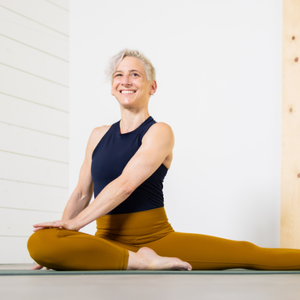
Find a spot in your home where you can lay out your yoga mat and stand with your arms out to the side in all directions.
That’s it. You don’t actually need a ton of space. You can see I ‘almost’ have enough space to do that, and this space is absolutely fine!
A wall often comes in handy so if possible, choose a spot with access to a clear portion of wall. BUT if that’s not possible, don’t sweat it! The wall is a prop and although it’s used sometimes in our classes, very often, a piece of furniture like the back of a sofa or a dresser can be an excellent stand in. For the times when a full wall is required, consider moving yourself into a hallway (even if it’s narrow) or in front of a closed door. There’s nothing wrong with moving around during your practice!
Carpet or not?
If you have options then by all means try both and see which you prefer. For me personally, I’d choose a hard floor over carpet because I enjoy the sensory feedback that a firm surface provides. That said, there’s absolutely nothing wrong with practicing Iyengar Yoga on carpet, grass, or other soft surfaces. I guarantee you that whichever environment you are in - whether it’s your home or the most deluxe yoga studio in the world, each practice space will have pros and cons. And those pros and cons will change depending on what poses you’re doing and how you approach them so this idea of having a PERFECT space for every possible yoga pose you might do, is really impossible. My best advice is work with what you have! It’s going to be great. Whether you are a beginner to Iyengar Yoga or advanced, you will be able to create a space that works for you.
Do I need a dedicated Iyengar Yoga space?
If you are in a position to allocate a dedicated home for your yoga mat, a place where you can just leave your yoga mat unrolled, I’d recommend giving it a try. It can be a great motivator because the mat is literally ready and waiting - it’s calling for you! BUT if you don’t have that space, you are not off the hook :). Currently, I’m enjoying practicing in the corner of my bedroom. For each practice, I move a small bench that sits at the end of the bed off to the side and unroll my yoga mat. I find that there is actually something quite centering about the act of preparing my space. It signals to my busy mind that it’s time to shift gears and do my yoga. Preparing the practice space has become part of my yoga ritual. And I’ll also add that rolling up my mat and putting my props away definitely helps to keep the dust bunnies at bay!
Props. What props do I need to begin an Iyengar Yoga practice?
For those of you who are just starting out with your online Iyengar Yoga practice, I want to tell you 2 important things about props. 1. It’s NOT necessary to purchase lots of props before you give yoga a try! There are lots of ways to improvise using common household items. For example, books, towels, cabinet, dining chair, etc. (demo use of alternate props). So again, to reiterate, you don’t need to purchase tons of props to get started. The most important thing is to get started, dip your toe in the pond of yoga - try a class and see how it goes. Now the 2nd thing I want to say about props is that even though it’s not required to purchase dedicated yoga props, most students do eventually purchase them and they generally say that having them makes their yoga experience even more enjoyable.
With those caveats out of the way, what props will be most useful to beginner students?
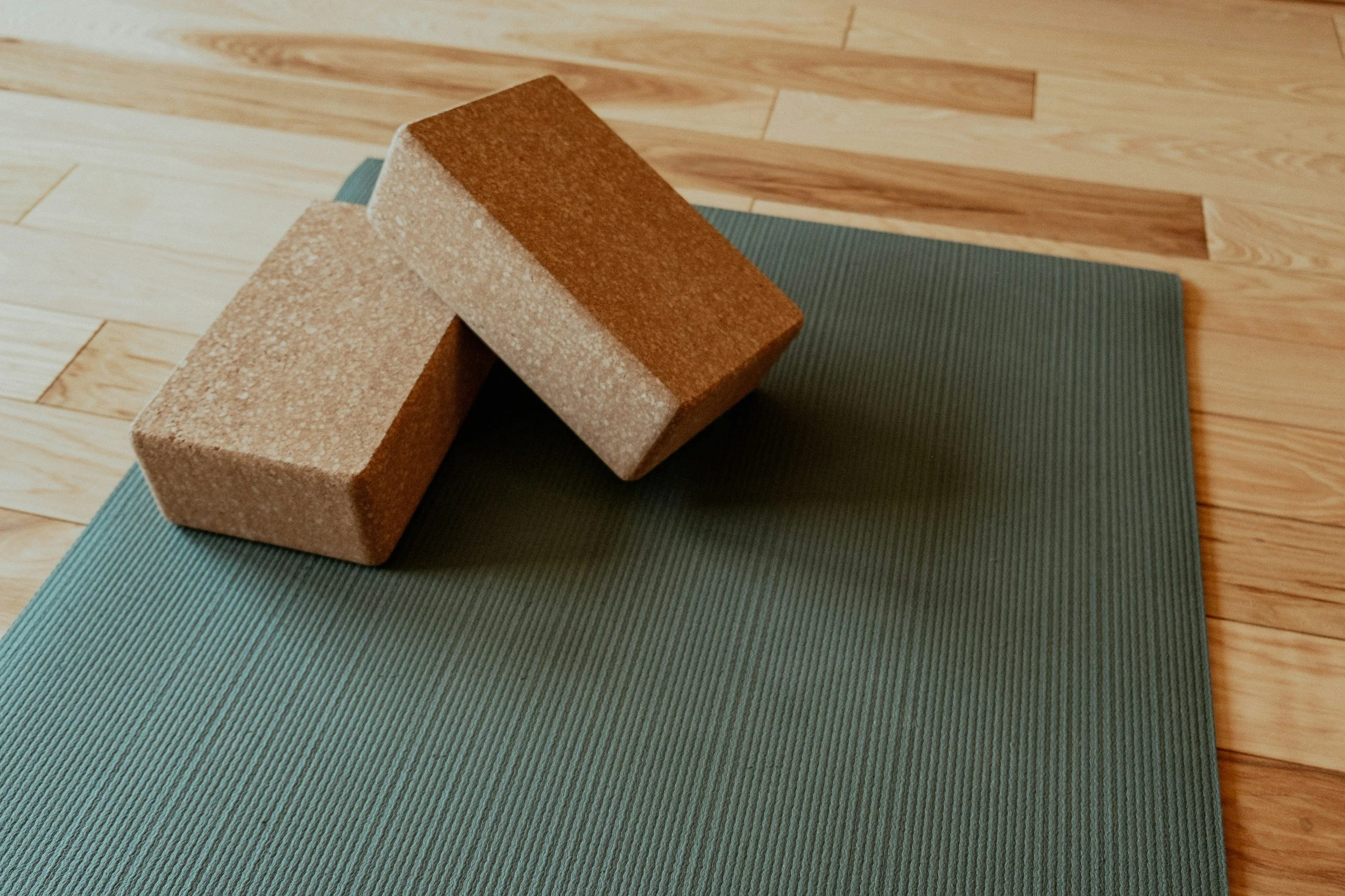
2 bricks
1 strap
1 chair
2 blankets
As you progress and incorporate shoulderstand into your practice, you may want to add
2 additional blankets
1 bolster
I’m not ready to purchase props. What can I use instead?
2 bricks - In many of the beginner poses, a chair can often be substituted for the bricks. And in cases when it can’t be, you can use a couple of books.
1 strap - a long tie perhaps from a robe
1 chair - For most beginner poses, any stable chair which is not on wheels and which doesn’t have arm rests will work well.
2 blankets - Large, thick, fluffy towels.
Technology. What do I need and how do I set it up?
You do not need a complicated technology setup to practice Iyengar Yoga online. A laptop, tablet, or even a phone can work. The most important thing is that you can see the screen clearly and hear the instructions comfortably from your mat.
If possible, position your device somewhere stable and at a height and distance that allows you to glance at the screen without constantly moving in and out of your pose. A laptop on a table, a tablet on a stand, or a phone securely propped up can all work well.
Before you begin, take a moment to test your setup. Can you see the screen from where you will be practicing? Is the volume loud enough? Will you be able to move around your mat without worrying about knocking your device over?
A few simple things can help:
Make sure your device is charged or plugged in.
Use a screen size that feels comfortable for you. A larger screen can make demonstrations easier to see, but it is certainly not essential.
Make sure the volume is loud enough to hear instructions clearly.
Turn off notifications and other distractions before you begin.
If possible, place your device somewhere you can see it without having to repeatedly twist your neck or strain to look at the screen.
And remember, you do not need to watch every second.
As you become more familiar with the poses and the language of Iyengar Yoga, you may find yourself listening more and looking less. In many ways, that is part of the practice too: learning to hear an instruction, notice what is happening in your own body, and respond.
Your setup does not need to be perfect. Start with what you have, make small adjustments as you go, and allow your home practice space to evolve with you.
Okay, that’s it. You’re set up. Now, it’s time for your Iyengar Yoga class!
New to Iyengar Yoga?
If you are beginning your practice, you may find our guide to what Iyengar Yoga is and how the method works helpful.
Want Po in your inbox?
Stay connected with new articles, videos, and updates from the studio.